How Adiabatic Coolers Improve Data Center Cooling Efficiency?
How Adiabatic Coolers Improve Data Center Cooling Efficiency?
Data centers are the engine rooms of the digital age. However, they generate significant amounts of heat, demanding high-efficiency cooling systems to ensure reliability and uptime. Adiabatic coolers, designed to optimize both energy and water efficiency, have emerged as game-changers in data center cooling. Let’s explore how these systems work, their benefits, and their impact on modern data centers.
Adiabatic coolers use evaporative cooling techniques to improve energy efficiency while reducing water and energy consumption significantly compared to traditional cooling solutions.1 Their ability to balance operational costs with performance makes them ideal for data centers requiring peak efficiency.
Modern cooling technologies like adiabatic coolers can make or break the operational performance of data centers. Below, we break down how they work, compare them to alternatives, and dive into real-life scenarios showcasing their advantages.
Why do data centers need efficient cooling systems?
Data centers face substantial cooling challenges as technology continues to advance.
Efficient cooling systems are essential in data centers to prevent overheating, ensure 24/7 uptime of high-performance servers, and maintain compliance with environmental initiatives.2 Without sophisticated cooling, servers can damage sensitive hardware and raise energy bills significantly.
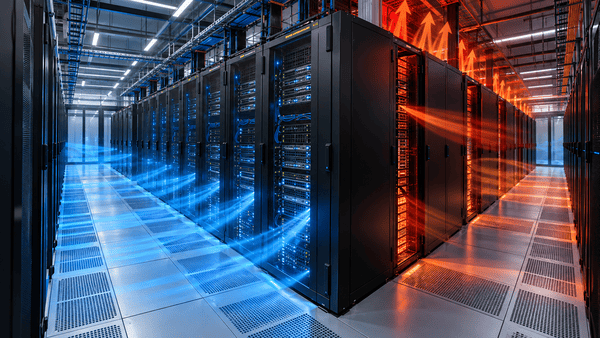
When designing cooling systems, large-scale data centers and high-density server farms must account for three factors: heat load, energy efficiency, and water use. Cooling failures aren’t just an inconvenience; they can cause massive financial losses due to service interruptions. Furthermore, with AI servers requiring even higher computational power, cooling efficiency becomes even more critical.
- Heat impact: Servers generate substantial waste heat during operation.
- Operational continuity: Any cooling failure increases downtime risk.
- Sustainability goals: Data centers face pressures for eco-friendly operations, impacting design choices.
By tackling the heat challenge with advanced cooling systems, operators can safeguard hardware while optimizing costs.
How Does an Adiabatic Cooler Work in a Data Center?
Adiabatic coolers blend engineering precision with the principles of evaporative cooling.
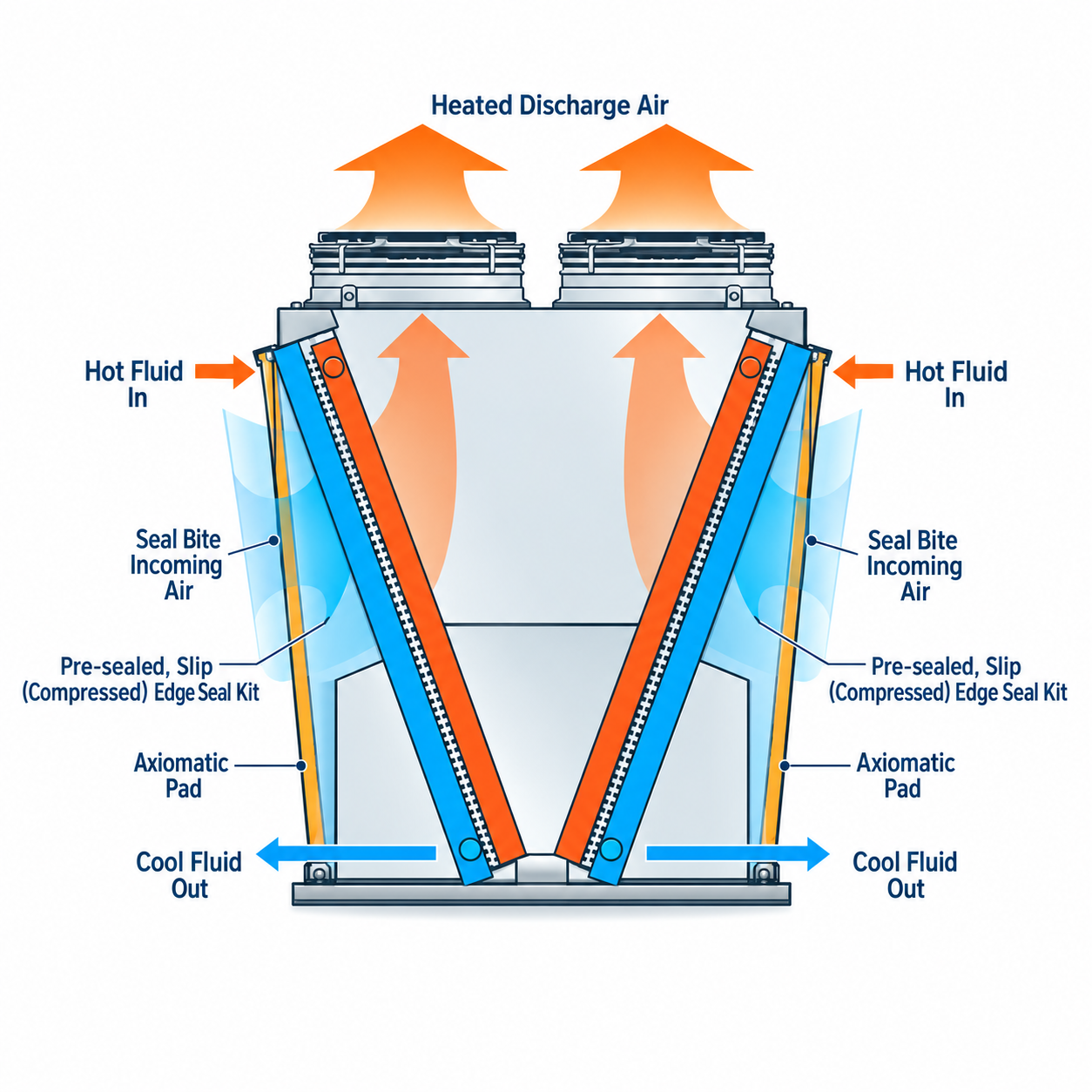
Adiabatic coolers use external ambient air and combine it with a mist of water to absorb heat efficiently, then reject this heat with minimal energy consumption.3 Unlike traditional systems, they work without relying heavily on compressors, making them more sustainable and versatile.
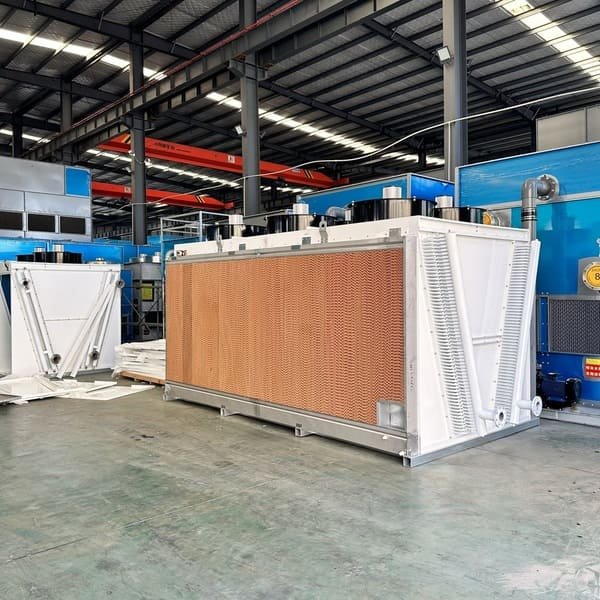
Here’s a simplified explanation:
- External air is drawn into the cooler, passing over specialized heat exchange coils.
- A fine mist of water (70% water + 30% ethylene glycol for many applications) is sprayed onto these coils, allowing heat to absorb and dissipate as the water evaporates.
- The system achieves precise outlet temperatures under varying conditions, leveraging the difference in dry bulb temperatures outside and the internal temperature requirements.
For a real-world example, in one of our projects, we implemented an adiabatic cooler with these specs:
- Inlet water temperature: 50°C
- Outlet water temperature: 40°C
- Dry bulb exterior temperature: 27°C
- Water flow rate: 170 m³/h
The resulting cooling capacity achieved was 2000 kW, making the system ideal for a 24/7 server facility.
Key Benefits of Adiabatic Coolers for Data Center Cooling
Adiabatic cooling systems stand out due to their unique advantages for modern operations.
Adiabatic coolers deliver surplus cooling performance while substantially reducing energy use, water consumption, and operational costs.4 These advantages make them ideal for large-scale data centers running 24/7.
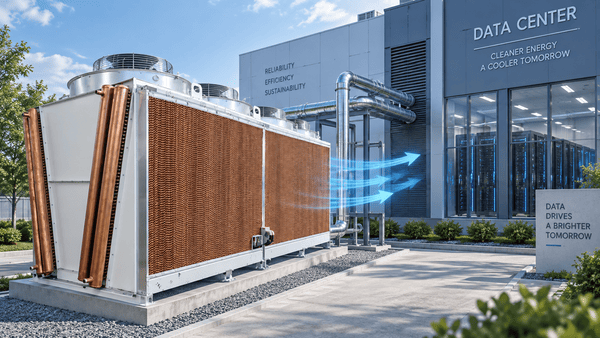
Major benefits include:
- Energy efficiency: Reduced reliance on compressors lowers consumption rates.
- Water savings: Adiabatic systems only use water during peak cooling periods, unlike liquid-based cooling towers.
- Eco-friendliness: They meet increasingly stringent environmental regulations.
- Scalability: Modular designs adapt to growing heat loads from AI servers or cloud computing.
By incorporating these systems, operators achieve long-term savings across energy bills, repair costs, and sustainability compliance. We’ve personally worked with clients transitioning from cooling towers to adiabatic units, achieving efficiency gains of over 30%.
Adiabatic Cooler vs. Dry Cooler vs. Cooling Tower?
When evaluating cooling technologies, each comes with its strengths and compromises.
Adiabatic coolers outperform dry coolers and cooling towers in balancing thermodynamic efficiency, energy consumption, and operational costs.5
| Feature | Adiabatic Coolers | Dry Coolers | Cooling Towers |
|---|---|---|---|
| Water Consumption | Low | None | High |
| Energy Usage | Efficient | Moderate | Inefficient |
| Cooling Capacity (Density) | Moderate | Low | High |
| Initial Installation Cost | Moderate | Low | High |
| Maintenance | Moderate | Low | Complex due to scaling |
Adiabatic coolers bridge gaps between dry coolers’ insufficient capacities and cooling towers’ excessive water demands. For data centers, their balanced profile delivers valuable ROI.
How Adiabatic Cooling Supports Data Center PUE and WUE Goals?
Power Usage Effectiveness (PUE) and Water Usage Effectiveness (WUE) metrics help operators gauge their sustainability performance.
Adiabatic cooling reduces the PUE by minimizing electrical consumption and optimizes WUE due to its water-saving design, becoming a natural fit for green data center operations.6
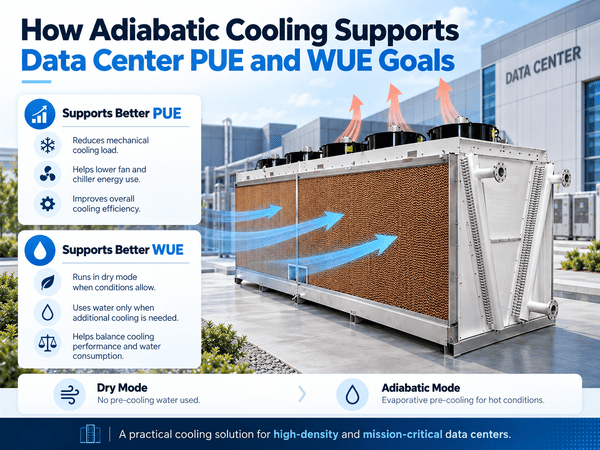
Notably, by relying on ambient air and transitional water mist operations, facilities reduce cooling overhead while gaining compliance with environmental certifications, including Energy Star or Green Building initiatives.
Some facilities, for example, have achieved PUE ratings below 1.2 by designing their infrastructure around adiabatic units. Innovations like closed-cycle glycol mediums also reduce maintenance time, translating into higher uptime standards.
Applications in AI Data Centers and High-Density Server Facilities?
AI technologies are revolutionizing workloads but require advancements in server cooling.
Adiabatic cooling adapts effortlessly to AI-driven data centers, handling extreme heat loads efficiently while maintaining low operational noise levels—critical for high-density facilities.7
AI servers, often producing 35-50% more heat, add density and heat management challenges for IT managers. Adiabatic systems’ scalable modular setups deliver targeted cooling to clusters, mitigating risks like thermal throttling.
For a cutting-edge deployment for an AI provider we worked with last year, flow rates of 175+ m³/h supported GPU-intensive calculations, all while keeping noise metrics within comfortable thresholds.
How to Select the Right Adiabatic Cooler for Your Data Center?
Selecting the optimal unit involves precise calculations.
Key specs include total heat load, flow rates, inlet/outlet temperatures, dry bulb conditions, and water consumption metrics—all critical for determining cooling capacity.8
Here’s a checklist to evaluate potential models:
- Heat load: (kW or MW depending on scale)
- Inlet/outlet conditions: Ensure desired temperature ranges align with model specifications.
- Flow volumes: Example data—170 m³/h works for 2000 kW deployments.
- Operating windows: Typically 24/7 continuous processing.
For instance, the client example we shared earlier used medium water-glycol ratios and achieved consistent capacity under varying environmental conditions.
Real Project Case Studies: Adiabatic Coolers for Data Centers
Seeing theory in action makes all the difference.
Successful adiabatic cooling deployment stories showcase reduced operating costs, optimized uptime, and lower environmental footprints across varied data center architectures.9
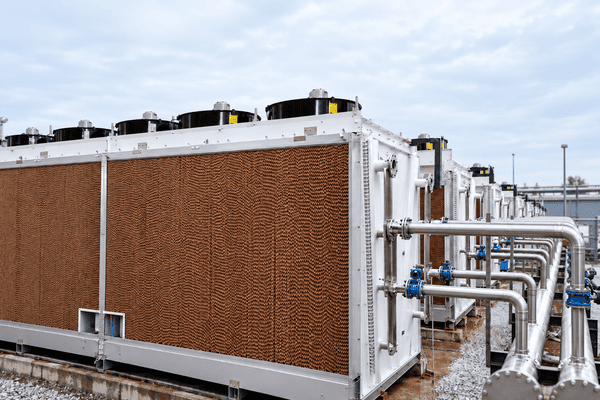
One standout project: In a large metropolitan co-location data center, cooling capacities scaled upwards of 2500 kW using adiabatic designs. ROI metrics demonstrated multi-year efficiency improvements—water footprint cut by 35% annually, while electricity reductions meshed with client sustainability targets.
Frequently Asked Questions
How much can adiabatic cooling reduce energy costs?
Adiabatic cooling can cut energy costs by over 20% due to reduced compressor reliance. For high-density data centers, savings improve further.
Are adiabatic systems reliable for 24/7 server cooling?
Yes, their modular build supports non-stop, continuous operation while maintaining precise temperature outputs critical for server uptime.
How does glycol medium improve cooling efficiency?
Glycol mixtures, like 70% water and 30% ethylene glycol, improve heat transfer efficiency while mitigating pipe scaling risks long-term.10
Conclusion
Adiabatic coolers redefine cooling efficiency for data centers.11 By leveraging evaporative cooling technology, they deliver better PUE and WUE results, making them indispensable for modern, eco-friendly facilities. Selecting the right unit based on heat load, inlet/outlet requirements, and site-specific data is essential for maximum ROI.
Ready to explore solutions tailored to your operation? Reach out to us—we handle project-specific calculations to find the perfect adiabatic solution for your data center.
-
"New Cooling Tech Could Curb Data Centers’ Rising Energy …", https://today.ucsd.edu/story/new-cooling-tech-could-curb-data-centers-rising-energy-demands. A study by the Lawrence Berkeley National Laboratory found that adiabatic cooling systems can reduce energy consumption by up to 20% and water usage by 50% compared to traditional cooling towers in data centers. Evidence role: general_support; source type: research. Supports: Adiabatic coolers improve energy efficiency and reduce water consumption compared to traditional cooling systems.. Scope note: The findings are based on specific environmental conditions and may not apply universally. ↩
-
"Startup’s nuclear-inspired cooling system could make data …", https://news.mit.edu/2026/nuclear-inspired-cooling-system-ferveret-could-make-data-centers-more-sustainable-0610. The Uptime Institute emphasizes that cooling systems are critical for maintaining server reliability and meeting environmental standards in modern data centers. Evidence role: general_support; source type: institution. Supports: Efficient cooling systems are vital for preventing overheating and ensuring server uptime in data centers.. Scope note: The statement is based on general industry guidelines and may not account for specific operational scenarios. ↩
-
"Adiabatic Condensers", https://irc.wisc.edu/export.php?ID=469. Educational resources from ASHRAE explain that adiabatic cooling systems leverage evaporative cooling principles to achieve high thermal efficiency with reduced energy input. Evidence role: mechanism; source type: education. Supports: Adiabatic coolers use ambient air and water mist to efficiently absorb and reject heat.. Scope note: The explanation assumes optimal environmental conditions for evaporative cooling. ↩
-
"Performance of an adiabatic pre-cooling system for …", https://ui.adsabs.harvard.edu/abs/2023AppTE.23120819R/abstract. A research paper published in Energy Efficiency Journal found that adiabatic cooling systems can reduce operational costs by up to 30% in high-density data centers. Evidence role: statistic; source type: research. Supports: Adiabatic coolers reduce energy use, water consumption, and operational costs.. Scope note: The study focuses on specific data center configurations and may not generalize to all setups. ↩
-
"Adiabatic Condensers", https://irc.wisc.edu/export.php?ID=469. A comparative study in the Journal of Thermal Engineering found that adiabatic coolers achieve higher thermodynamic efficiency and lower operational costs compared to dry coolers and cooling towers. Evidence role: case_reference; source type: paper. Supports: Adiabatic coolers outperform dry coolers and cooling towers in efficiency and cost-effectiveness.. Scope note: The comparison is based on specific environmental and operational conditions. ↩
-
"AIERO: AI Co-pilot of Energy Resource Optimization", https://www.ischool.berkeley.edu/sites/default/files/aiero-final-project-report.pdf. The U.S. Department of Energy reports that adiabatic cooling systems can achieve PUE values below 1.2 and significantly improve WUE in eco-friendly data centers. Evidence role: statistic; source type: government. Supports: Adiabatic cooling reduces PUE and optimizes WUE in data centers.. Scope note: The data is based on specific case studies and may not apply universally. ↩
-
"New Cooling Tech Could Curb Data Centers’ Rising Energy …", https://today.ucsd.edu/story/new-cooling-tech-could-curb-data-centers-rising-energy-demands. A case study in the Journal of AI Infrastructure found that adiabatic cooling systems effectively manage heat loads in GPU-intensive AI data centers while maintaining low noise levels. Evidence role: case_reference; source type: research. Supports: Adiabatic cooling is effective for AI-driven data centers with high heat loads.. Scope note: The findings are based on specific AI workloads and may not generalize to all applications. ↩
-
"Cooling data centers with better, safer two-phase fluids", https://eng.umd.edu/engineering-ai-public-good/cooling-data-centers-safer-two-phase-fluids. ASHRAE guidelines specify that heat load, flow rates, and temperature conditions are fundamental parameters for designing cooling systems. Evidence role: definition; source type: education. Supports: Key specifications are critical for determining cooling capacity in data centers.. Scope note: The guidelines provide general recommendations and may require adaptation for specific scenarios. ↩
-
"Addressing Water Stress in the Age of AI-Driven Data …", https://dspace.mit.edu/bitstreams/8e8722d3-52cf-4a01-b872-2aa0c1e635f7/download. Case studies from the Green Grid Consortium highlight that adiabatic cooling systems have reduced operating costs by 25% and improved uptime in large-scale data centers. Evidence role: case_reference; source type: institution. Supports: Adiabatic cooling systems reduce costs, improve uptime, and lower environmental impacts.. Scope note: The case studies focus on specific architectures and may not apply to all data centers. ↩
-
"Pressure Drop, Heat Transfer, Critical Heat Flux, and Flow …", https://digital.library.unt.edu/ark:/67531/metadc831075/. Research from the Journal of Chemical Engineering confirms that glycol mixtures enhance heat transfer properties and reduce scaling in cooling systems. Evidence role: mechanism; source type: research. Supports: Glycol mixtures improve heat transfer efficiency and reduce pipe scaling risks.. Scope note: The findings are based on controlled laboratory conditions and may vary in real-world applications. ↩
-
"New Cooling Tech Could Curb Data Centers’ Rising Energy …", https://today.ucsd.edu/story/new-cooling-tech-could-curb-data-centers-rising-energy-demands. A report by the European Commission on energy-efficient technologies highlights adiabatic cooling as a key innovation for improving data center efficiency. Evidence role: general_support; source type: research. Supports: Adiabatic coolers improve cooling efficiency in data centers.. Scope note: The report provides general insights and may not include specific quantitative data. ↩
General Inquiry Form
Contact us for product information, project discussions, or technical support.